A family history
From Kremenchuk
to Winnipeg
Seven generations of Sodomskys, two ships, one street, and the papers that prove all of it. Assembled for the family, September 2026.
Start with chapter one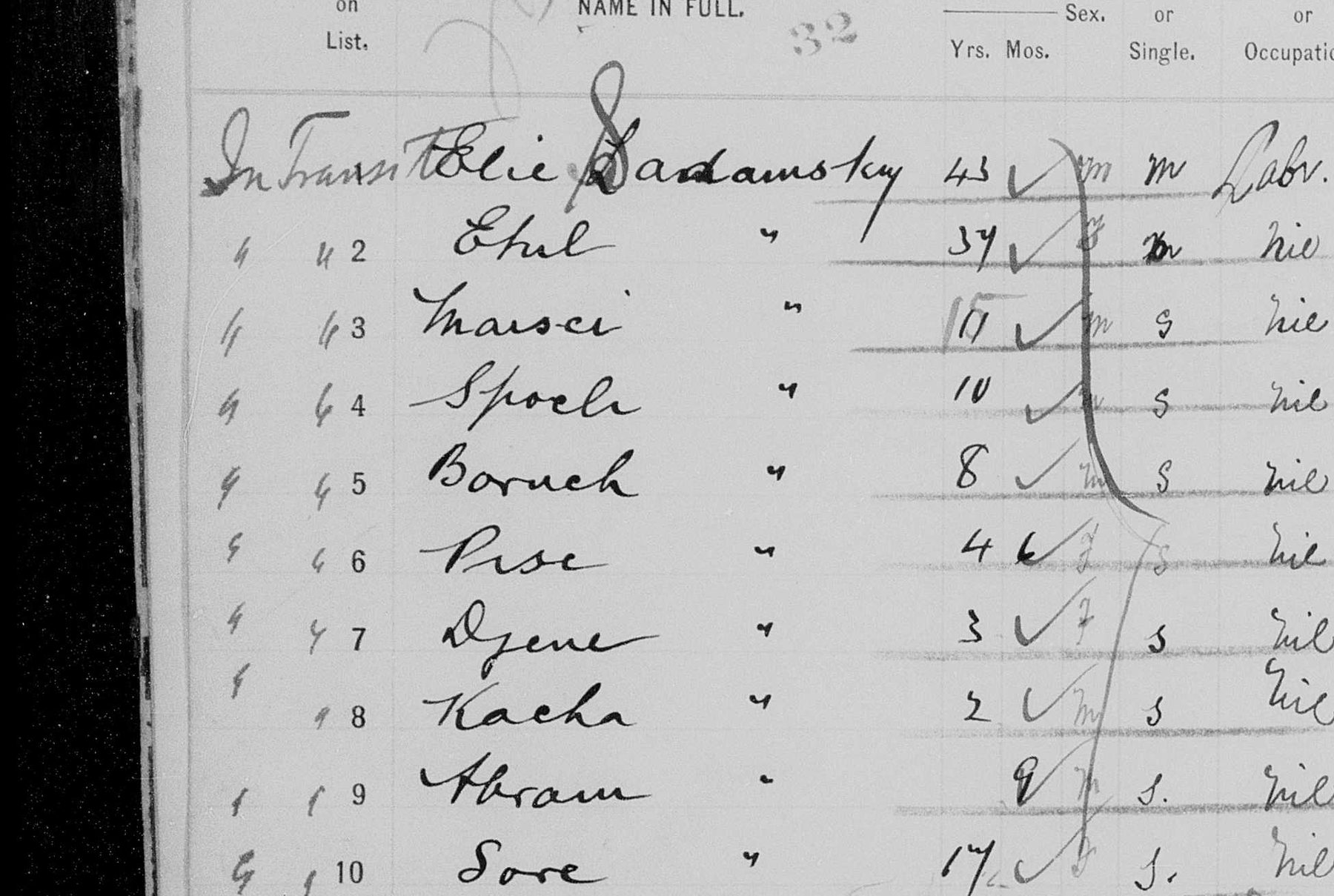
A family history
Seven generations of Sodomskys, two ships, one street, and the papers that prove all of it. Assembled for the family, September 2026.
Start with chapter oneAlmost everything on this page comes from documents that somebody filled out in ink between 1904 and 1954, and that, as far as anyone knows, nobody in the family had looked at since. Ship manifests, census sheets, border cards, a company charter. They turn out to tell a story with a shape: a boy sent ahead, a family that followed him, a jeweler who started over at 47, two brothers in two cities, and a name that split in two.
Tap any document to see it up close. The last chapter lists where every fact came from, and what nobody knows yet.
Chapter one · 1863 to 1904
The family name is a place name, and for a hundred years the town's name had not been written down anywhere this branch could find it. Now it has.
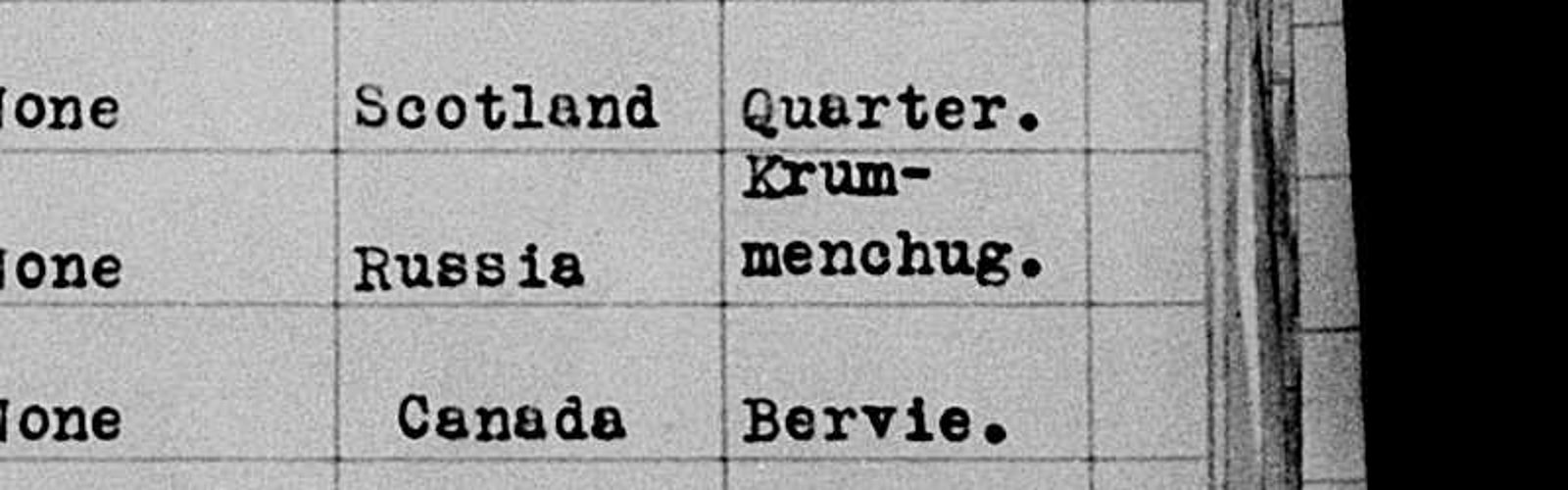
Eli Sodomsky was born on 18 August 1863. By the 1890s he and his wife Ethel Bercovitch were raising children in Kremenchuk, a river city on the Dnipro where nearly half the thirty thousand residents were Jewish, the largest Jewish community in Poltava province. Eli was a watchmaker, and the province's printed directory for 1892 lists him at his trade: among the watchmakers of Kremenchuk, Elya, son of Mordko, Sadomsky, in the house of Pidorchenko on Khersonskaya Street in Kryukov, the suburb across the Dnipro bridge. Kryukov was home: Morton gave it as his birthplace on crossings in 1925 and 1930, spelled Krukow and Krucov by the clerks, and a record attached to Albert says the same. The directory entry is the only record of the family in the town itself, and the patronymic is Mordechai written down in his own country. Their son Morton was born there in 1895, and when Morton sailed home to Winnipeg from a business trip in 1921 the clerk at New York wrote down his birthplace the way he heard it.
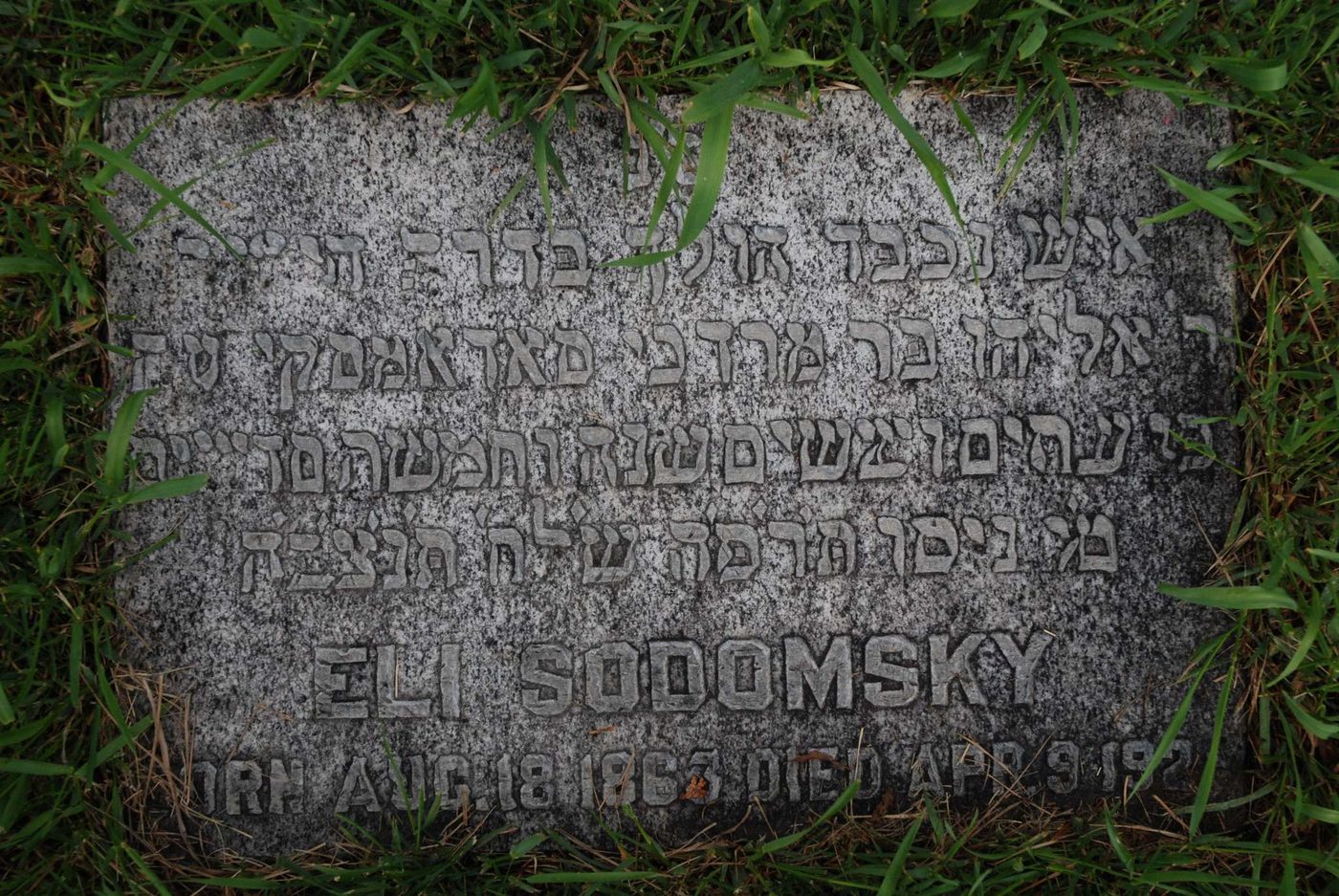
The name is the kind of surname a Jewish family took from a village in the early 1800s. In Russian it is Садомский, which comes into English as Sadomsky. In Winnipeg the family settled on Sodomsky, and that is the spelling this page uses for them. Where a record spells it otherwise, the record's spelling is kept, so a Sadomsky on this page is not a slip: it is the name as Kremenchuk wrote it, and as the people who never left still write it. Clerks heard it as Sadamsky in 1906 and Sadowisky in 1908. On Eli's gravestone in Winnipeg, in Hebrew letters, it is Sadamski, the way it sounded. The stone gives the same father: Eliyahu, son of Mordechai. Mordechai is as far back as the paper goes. Kremenchuk's Jewish birth registers did not survive the twentieth century.
The name did not leave with Eli and David. Two Kremenchuk-born Sadomskys, sons of an Abram and a Noy, are in the Russian army's casualty lists for 1916, and a Sadomsky household was still in the city when the German army arrived in September 1941: Lev, an engineer born in 1893, his wife Fira, an economic planner, and their daughters Maria, 19, and Sofiya, 9. Most of the city's remaining Jews were murdered that autumn. The Sadomskys were not among them: a Soviet list drawn up in August 1942 records all four evacuated to Shadrinsk in the Urals. Lev's father was named Aleksandr, born in the same decade as Eli and David, and he may have been a third brother who stayed. Nothing yet proves it, and only a descendant of Lev and Fira could settle it. If you are one, and you have found this page by searching your own name, please write.
Spelled Sodomsky, the name belongs almost entirely to this family: roughly eighty people, most of them in Manitoba, a few in the United States, and eleven in Israel who are not yet accounted for. Spelled Sadomsky, it survives in Russia, mostly far from Ukraine. Three Soviet Sadomskys made the encyclopedias, a chess master, a circus mentalist named Moisey, and a dissident historian. None has a recorded birthplace, and whether any of them descends from Mordechai's family is unknown.
Chapter two · September 1904
Moses went first.
In September 1904 the SS Canada docked at Quebec with a boy on line 43 of sheet 3, entered as Mosa Sodomsky, with uncle, occupation "Boy", destination Montreal, and a note squeezed in above the line: sent out by his father. He was written down as 10. He was really 13; the child fare was half price. The man on the line above him, with the consecutive railway ticket, is Gersch Lubinsky, 30, a labourer. He is almost certainly the uncle, Ethel's brother or a sister's husband. The name Lubinsky appears in none of the family's own records, but an older relative may well remember it; if you do, please say. Two Lubinsky households did settle in Winnipeg's North End within a couple of years: David, a pedlar at 271½ Dufferin Avenue, two blocks from Eli's house, and a John, born the same year as Gersch, with a wife Jena and a baby son named Moses. Either could be Gersch's family. Neither is proven to be.
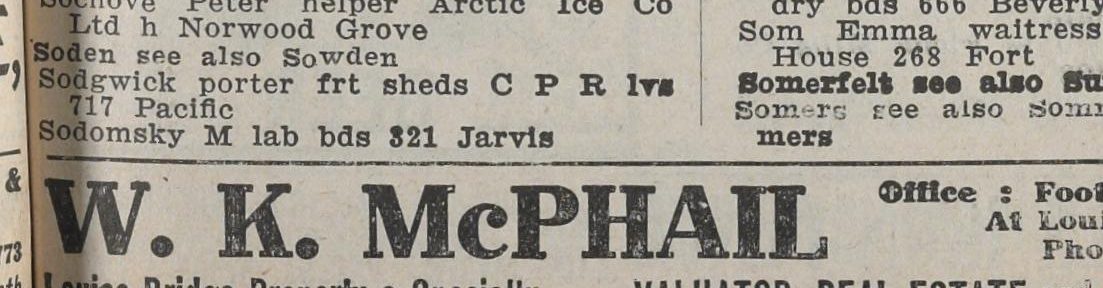
Two years later, when the rest of the family landed, Moses was already in Winnipeg, boarding at 321 Jarvis Avenue and listed in the city directory as a labourer. He was 15, and not the only relative there: Ethel's sister Rebecca, Mrs. Henry Bubinsky, had come to Winnipeg in 1905, and her obituary forty years later names "a sister, Mrs. Ethel Sodomsky". The family's tickets said Montreal, but they went where Moses was. Everything that follows follows him.

Chapter three · 26 March 1906
The Furnessia arrived at Ellis Island from Glasgow. The first ten lines of sheet 32 are the Sodomskys.
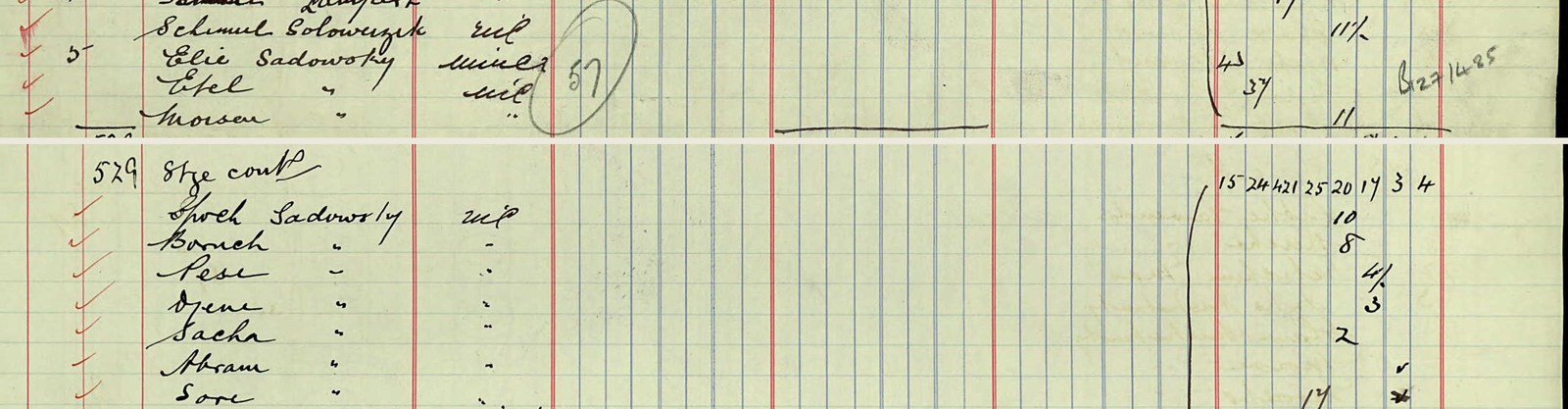
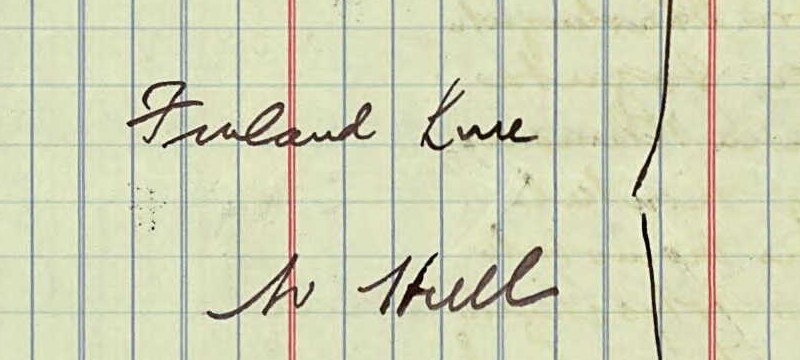
Elie, 43, "labourer", which he was not, carrying $450, about a year's wages for a working man in 1906 and roughly $17,000 in today's money; Ethel, 34; and eight children from seventeen years old down to nine months. Every line says Russia, Hebrew, last residence Poltava. All ten could read and write except Ethel. They were not staying: the inspector stamped Eli's line In transit, and the destination column says Montreal, Canada, care of a friend named Mordecai Eibel. The family on the lines below them, the Rabinowitzes, were from Poltava too and going to the same man. From Ellis Island they went straight to a train. The way in had been just as roundabout. The Glasgow sailing list carries the ten of them as "Sadowsky", transmigrants, with a note across the page: Finland Line, to Hull. They had left the empire by steamer from Finland to Hull, crossed England by rail, and boarded the Furnessia at Glasgow on 17 March.
Moses, 15, is not on the sheet: he had crossed in 1904. Elsie Alice, the ninth child, was born in Winnipeg in 1909.
Nobody in the family wrote down why. The dates speak instead. In April 1903 the Kishinev pogrom, five hundred kilometres to the southwest, killed 49 people and was reported around the world; emigration from the south of the empire roughly doubled in the years after it. In February 1904 Russia went to war with Japan and conscripted heavily in the Pale of Settlement, where Jewish families with sons near military age had every reason to get them out first. Moses was sent that September. In October 1905, after the Tsar's manifesto, the largest wave of pogroms in Russian history swept more than six hundred towns in two weeks, and Kremenchuk was one of them.
Five months later, Eli, Ethel and eight children were on a ship with a year's wages in cash and tickets to the far side of a second country. That is not a family trying its luck. It is a family that had decided, and moved as soon as it could. Winnipeg pulled as hard as Russia pushed: Moses was already there, so was Ethel's sister, an uncle had gone ahead to Canada, and the city was the fastest-growing on the continent, its North End filling with Jews from this same corner of Ukraine, where a jeweler with capital could see a market that did not exist at home.
| Line | As written | Age | Who they became |
|---|---|---|---|
| 1 | Elie | 43 | Eli, 1863 to 1925 |
| 2 | Ethel | 34 | Ethel Bercovitch, c.1871 to 1958 |
| 3 | Marsci | 11 | Morton Frank, 1895 to 1957 |
| 4 | Spoch | 10 | A child not matched to anyone after 1906 |
| 5 | Boruch | 8 | Bennett, 1896 to 1980 |
| 6 | Pise | 4 | Nellie: her gravestone gives her Hebrew name, Pessia |
| 7 | Djene | 3 | Probably Annie, born 1899 |
| 8 | Kacha | 2 | Probably Sam, 1903 to 1979 |
| 9 | Abram | 9 mo | Albert "Abe", born 1905 |
| 10 | Sore | 17 | Sarah, later Mrs. Samuel Weiner |
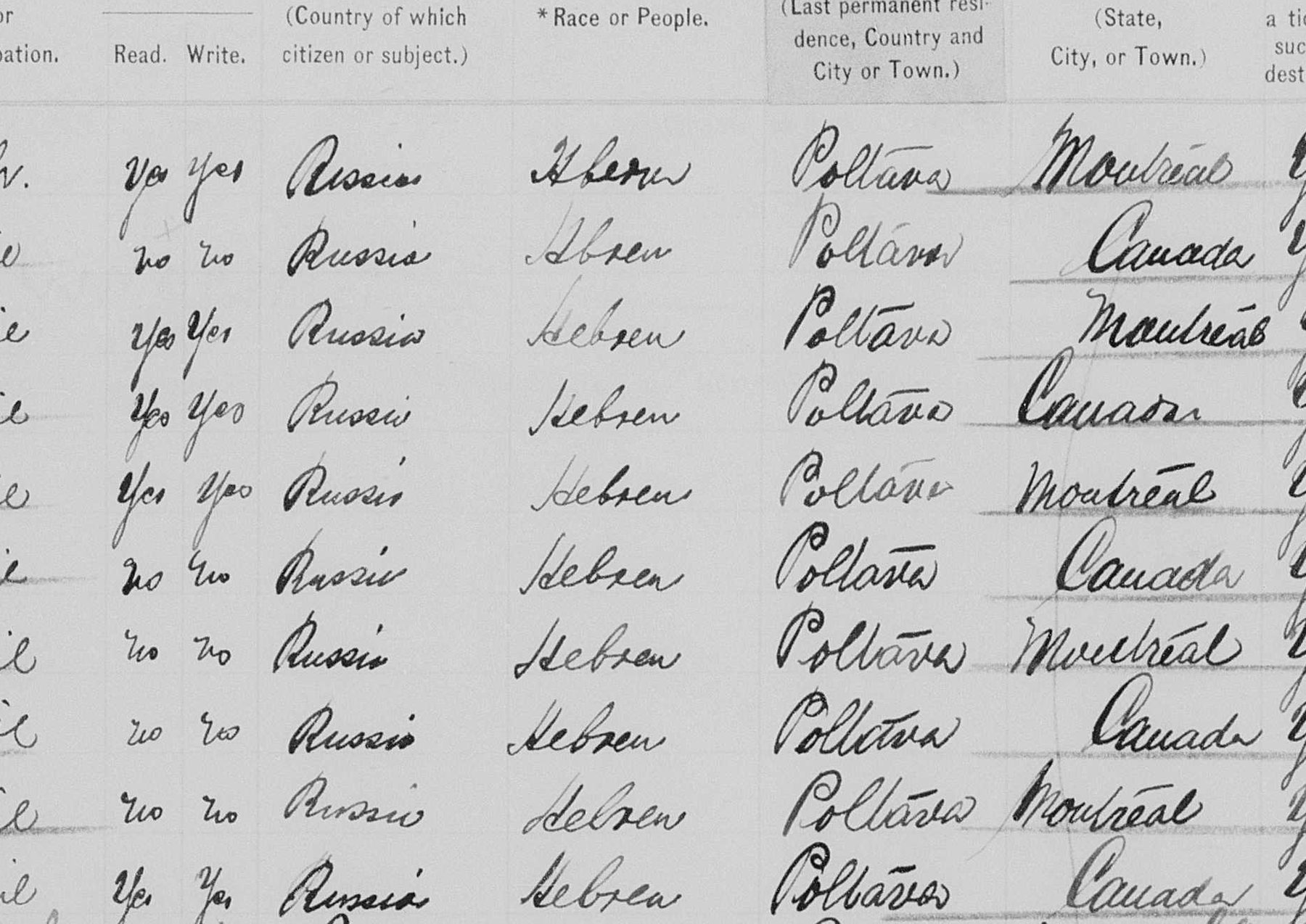
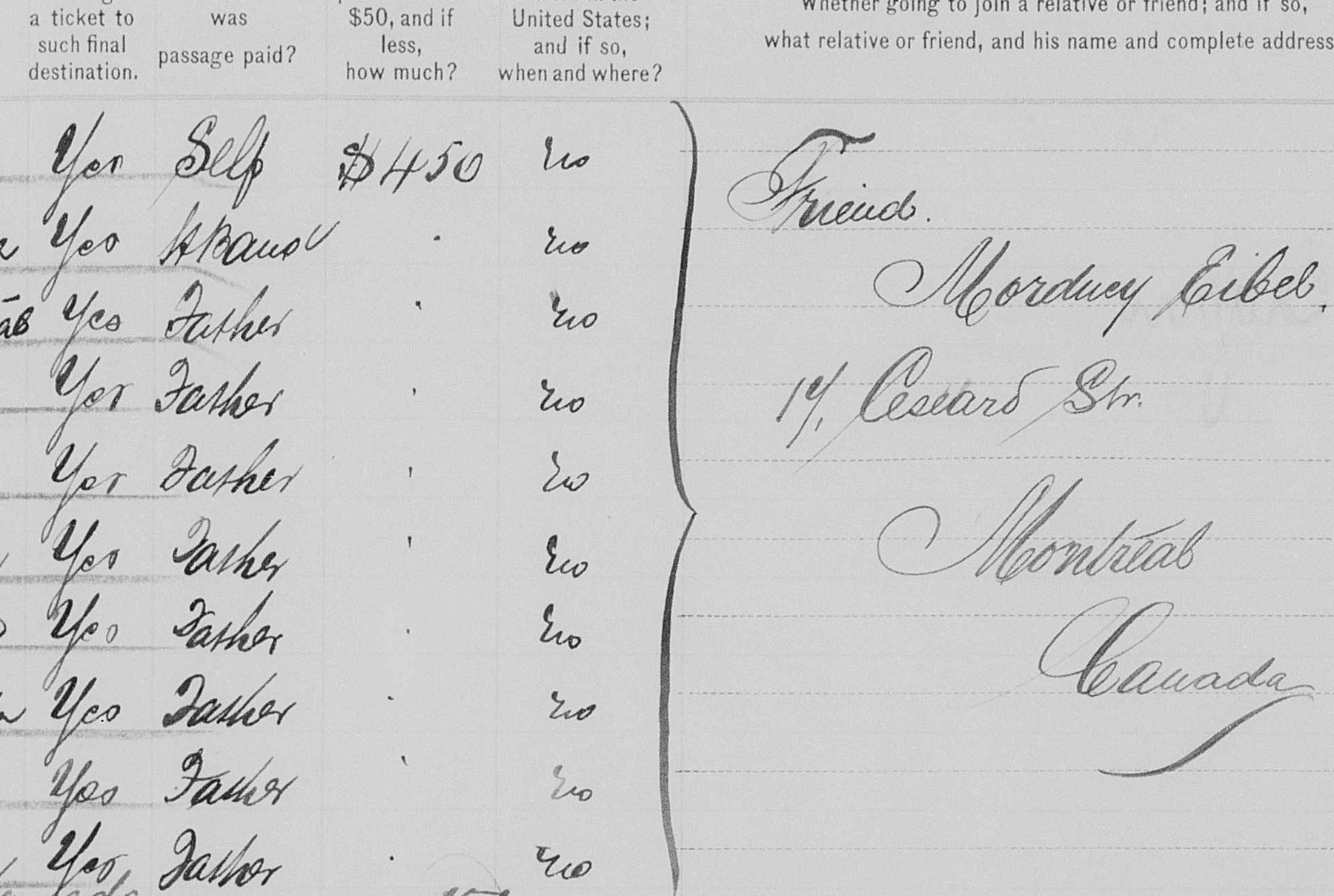
Sheet 32, lines 1 to 10, in three pieces. Left: names and ages. Centre: nationality, race and last residence. Right: money carried, the In transit stamp, and destination. The whole sheet opens on tap.US National Archives T715 · FamilySearch film 7648737, frame 423
Chapter four · 1906 to 1931
Within four years of arriving with "labourer" on his papers, Eli had his name over a shop.
The 1910 directory lists Eli Sodomsky, proprietor, Scandinavian Jewelry Co, 638 Main Street, with Morton clerking for him and the family living at 314 Dufferin Avenue in the North End. By 1911 the shop carried his own name, E. Sodomsky, wholesale jewelers, and Moses was its watchmaker. Ben and Sam came in as they grew up; the 1913 directory has Eli, Ben and a cousin Max all at the store and all living at 22 Aikins Street.
On 21 February 1924 the family made it official. E. Sodomsky & Sons, Limited, was incorporated with capital of $75,000, its members Eli, Morton Frank, Ben, Sam and Moses Sodomsky, "all of Winnipeg, Manitoba, merchants." Eli died fourteen months later, on the first day of Passover 1925, aged 61. Ethel ran the company after him. The 1931 directory lists her plainly: Mrs. Ethel Sodomsky, manager, E. Sodomsky & Sons Ltd. By then the firm had a Toronto office too, on Bay Street, where Morton, who had moved east in 1922, imported Swiss watches, and where Albert followed him. The 1931 census found Ethel at 127 Home Street, head of the household in a ten-room brick house, with three of her married children counted under her roof as well as at their own. Nell's husband David Samuels sold for the firm on the road; he and Sam later spun off the National Jewelry Company, the wholesale jewelry business where David Eli got his first job.
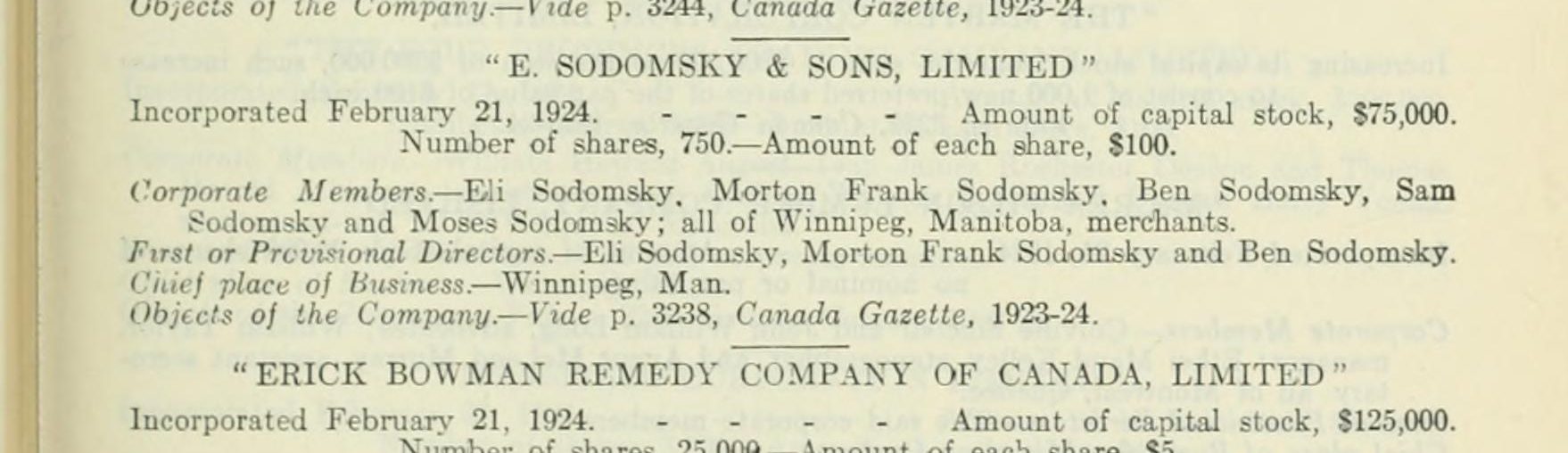
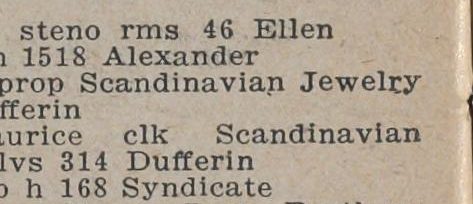
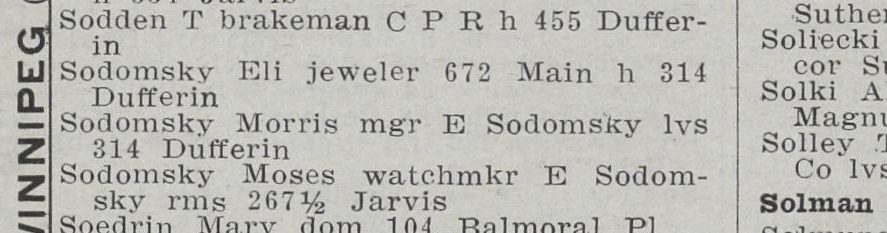
Left, 1910: "Eli, prop, Scandinavian Jewelry Co, h 314 Dufferin," misprinted Godomsky. Right, 1911: "Eli, jeweler, 672 Main"; "Morris, mgr, E. Sodomsky"; "Moses, watchmaker, E. Sodomsky, rms 267½ Jarvis."Henderson's Winnipeg City Directory, 1910 and 1911
Chapter five · 1908 to 1924
Eli was not the only Sodomsky to make the trip.
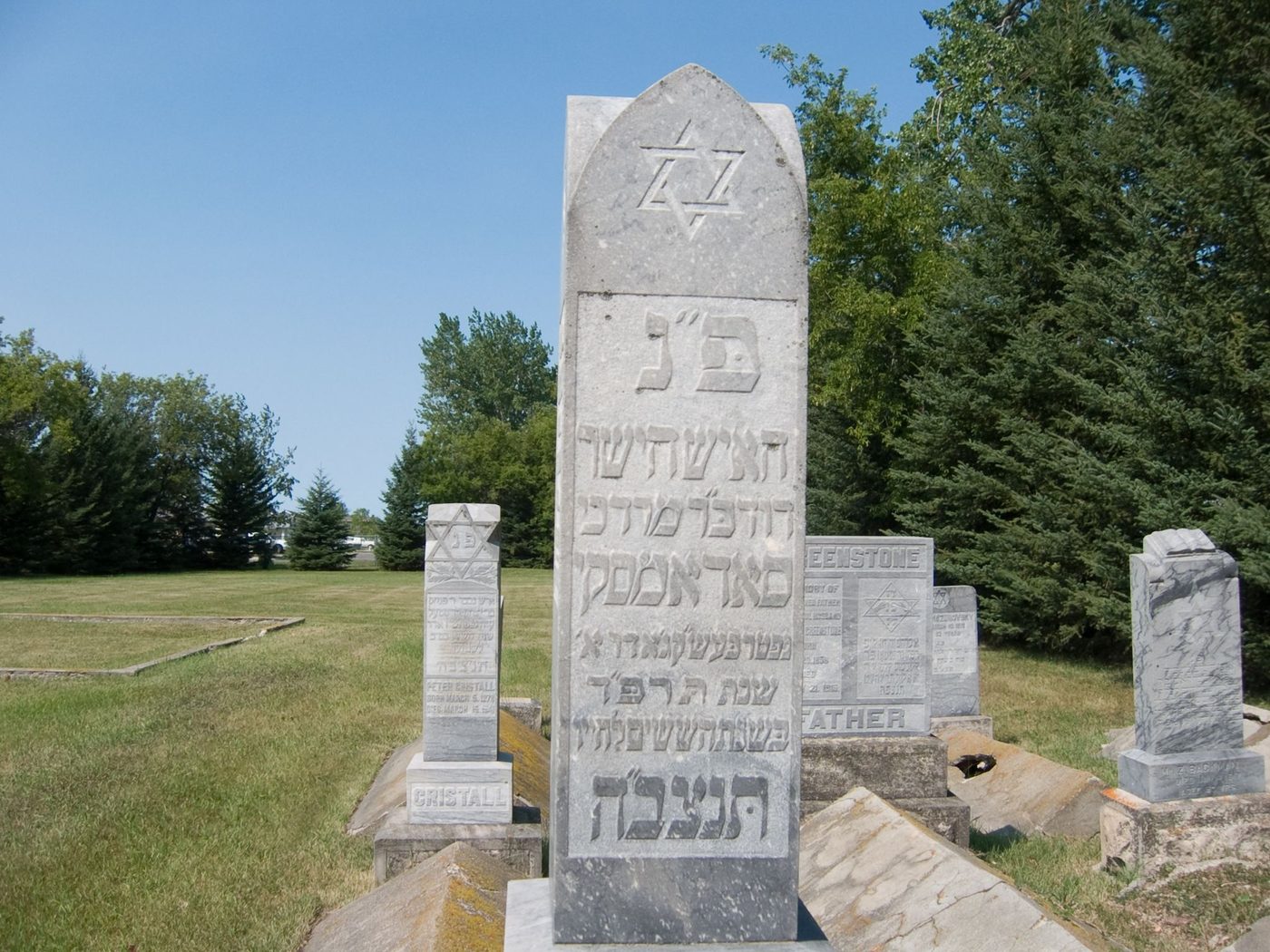
David Sodomsky was born in September 1864, thirteen months after Eli. He was also a jeweler, also from Kremenchuk, and his gravestone in Brandon also reads son of Mordechai. His wife Zlate, née Ginsburg, and four of their children landed at Halifax in March 1908 on the SS Victorian, bound for Winnipeg, where David had gone ahead: a David Sodomski, 40, had landed at Saint John, New Brunswick in January 1905, four months after Moses, and by 1906 David was in Brandon. The eleven-year-old on the sheet is written down as Mordechai, named for the grandfather. In 1908 a Jacob Sodomsky, very likely David's eldest, was running a jewelry shop at 644 Main Street, two doors from where Eli would set up.
By 1911 David's family was two hundred kilometres west in Brandon at 1117 Assiniboine Avenue, and in 1913 David and his son Morris opened the Palace Jewelry Co on Tenth Street. That same year David's son Max was a clerk in Eli's shop in Winnipeg and living in Eli's house. Two jewelers named Sodomsky, born a year apart, each "son of Mordechai", from the same province, trading sons between their stores. No document calls them brothers. Everything else does.
Brandon's newspaper followed the family: David was vice-president of the B'nai Israel congregation, and his son Morris staged and starred in a Yiddish King Lear at City Hall in 1914 and played violin at concerts around town for years after. David died in February 1924. Zlate married again the next year, Hyman Cooperman of Brandon, and lies in Winnipeg as Zlata Cooperman, daughter of Yehuda Leib. The family scattered too. Norman, born in Poltava in January 1892, crossed into the United States in 1917, spent some years in Minneapolis with his brother Max, and married in the Bronx in 1925; he was a cutter in a ladies' belt factory there and a naturalised American by 1940. His son Daniel and Daniel's children are the Sodomskys of New York, and it appears New Jersey and North Carolina, today. Max stayed in Minneapolis as Max Sanders, his 1942 draft card still giving his birthplace as Kremenchug; his children Deera and David's families are the Minneapolis cousins.
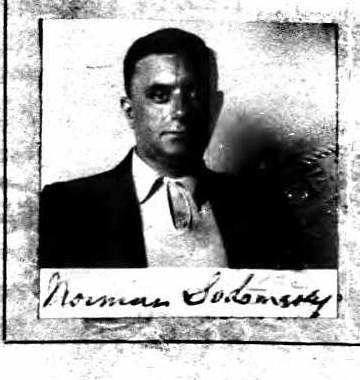


Chapter six · 1888 to 1909
Eli's death notice in 1925 counted five sons and four daughters. It took the manifest, the census and four obituaries to put names to all nine.
The census taker on 1 June 1911 found Eli, "salesman, wholesale", at home with Ethel and seven children, and wrote 1906 in the immigration column beside every one of them born in Russia. Moses, married by then, was three streets away with Fanny and two babies. The four daughters married in Winnipeg and Toronto, and ended up in Winnipeg, New York and Los Angeles.

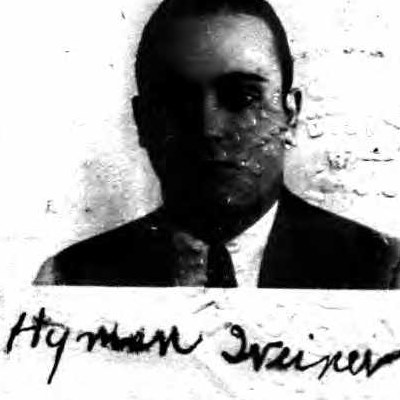
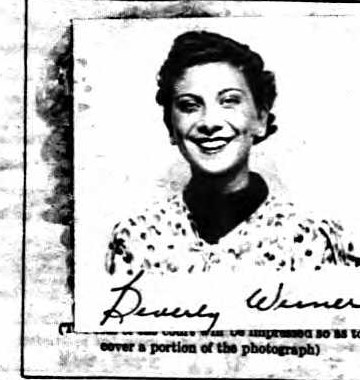
The eldest. Married Samuel Weiner. Her children Hyman, Fred and Beverly were born in Winnipeg between 1908 and 1914. In October 1923 the family took the Canadian Pacific train to New York, where Sarah died in 1949.
Crossed alone at 13. Watchmaker, then pipe coverer, then founder of Western Asbestos. Married Fanny Schwartzman, then Sarah Roisman. Seven children; the youngest, David Eli, is where the living branches in chapter nine begin.
Jeweler and a director of E. Sodomsky & Sons. Moved to Toronto in 1922 to run the firm's office there; married Rose Greisman in 1924. Their daughter Hudas Charendoff died in Toronto in 2024, aged 96. The one whose paperwork names the town.
Bookkeeper, then partner in the firm, and its buyer abroad: New York arrival lists have him coming back from Paris in 1924, 1927 and 1929. Married Helen Kushner, born in Kishinev, in 1922.
Married David Theodore Samuels in 1922. Their daughter Elyse wrote the memoir that first named "Eli Sodomsky, founder of E. Sodomsky & Sons." Elyse married Rivan Halprin; their daughter Susan married Bryan Klein; Susan's daughters Baillie, Sarry Nell and Julie are Nell's great-granddaughters and still in Winnipeg.
Married Maurice Lax in Toronto in 1928; the "Mrs. M. Lax" of her mother's obituary. He died in Los Angeles in 1959. She came home to Winnipeg and died there in 1979, buried at Shaarey Zedek as Henye, daughter of Eliyah.
Partner in the jewelry firm, then National Jewelry, then National Record Distributions. Married Sadie in 1924.
"Abe." Nine months old at Ellis Island. Followed Morton to Toronto, married Edythe Fogle there in 1929, and from the 1940s was Albert Saunders.
The first Sodomsky born in Canada. Married Benjamin Selman, an accountant, and lived in the Bronx as Alice Mae Selman; died in Los Angeles in 1976, where her sister Annie had gone before her.
Chapter seven · January 1925
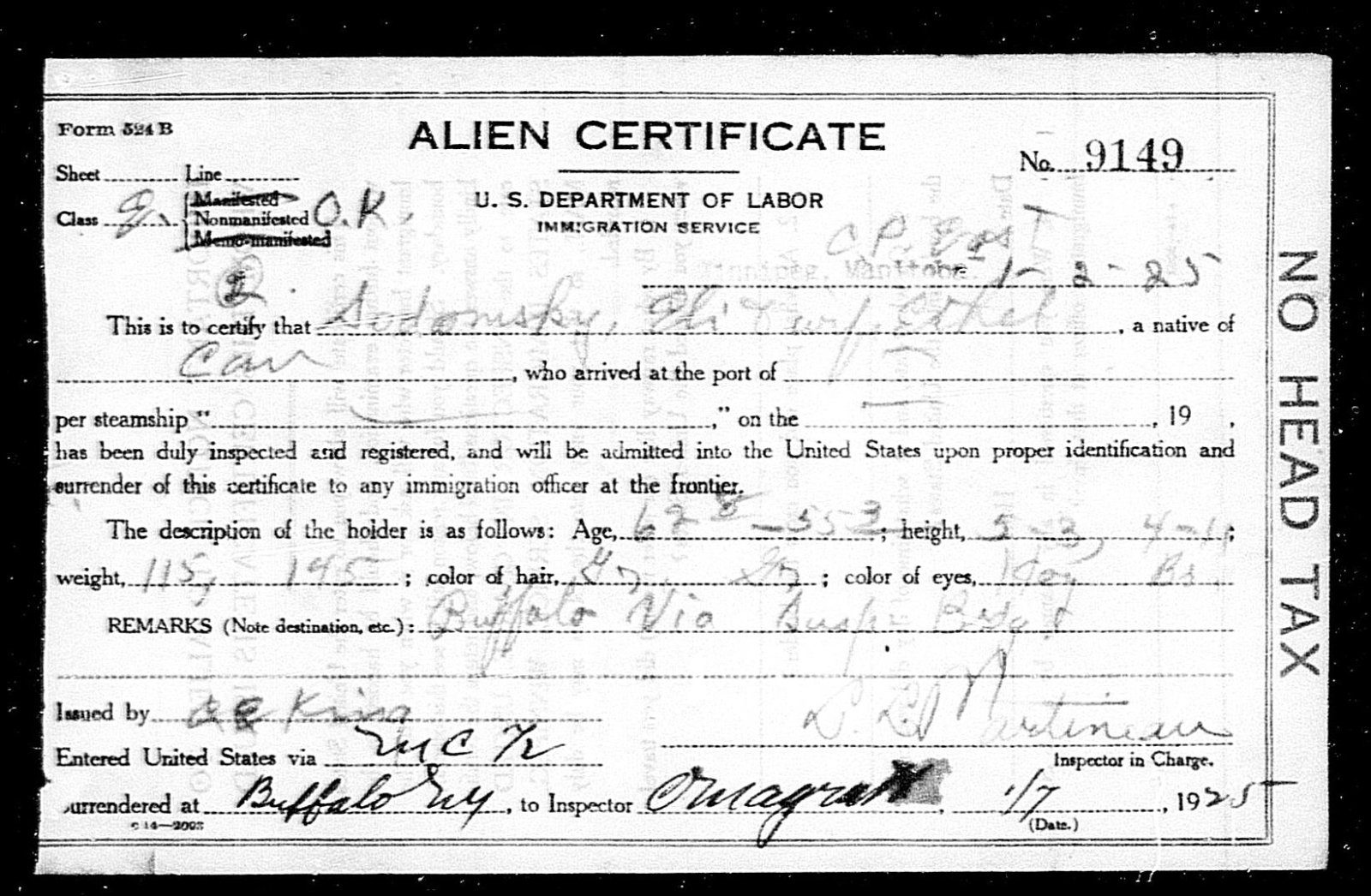
No photograph of Eli or Ethel has turned up. This card is the closest thing.
On 2 January 1925 they took a winter trip to Buffalo by the Michigan Central Railroad, probably to see one of the daughters in the United States. The Canadian Pacific Express office in Winnipeg typed out a certificate for the border, and the inspector filled in the description of the holder. Eli, 62: five feet three inches, 115 pounds, grey hair, grey eyes. Ethel, 55: four feet eleven, 145 pounds, grey hair, brown eyes.
Every inch on that card is one of the few things we know about them that nobody wrote down for posterity. It was written down so a man at a bridge in Buffalo could check it was the same couple. Three months later, on the first day of Passover, Eli died at home. The Israelite Press reported "his wife, five sons and four daughters." Ethel outlived him by 33 years.
Chapter eight · 1910 to 1976
Moses left the jeweler's bench early, and built the other family business.
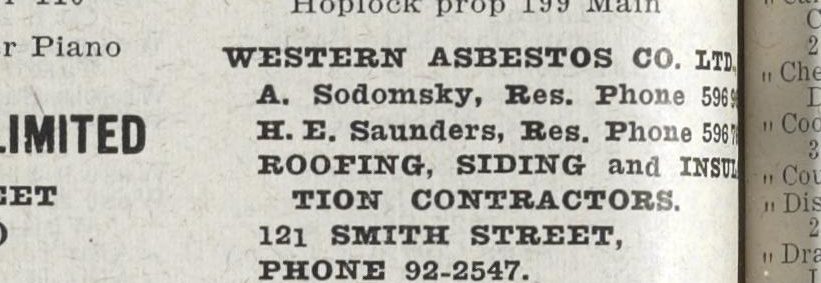
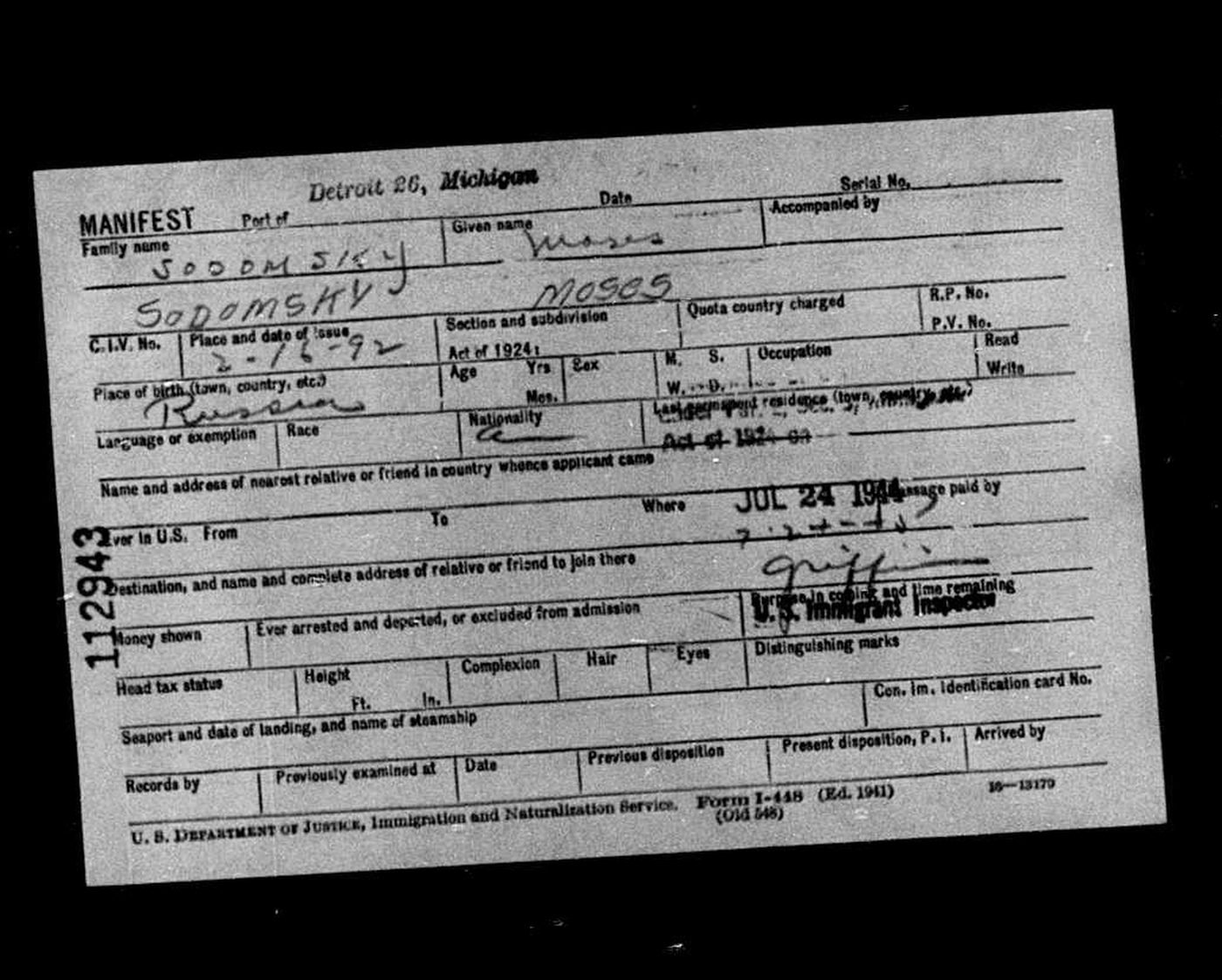
In 1910, at twenty, the directory lists him as a "pipe coverer" for the Western Mackolite Company: insulation work, pipes and boilers. Eighteen years later, the company's own history says, Johns-Manville asked Moses Sodomsky to start an insulation contracting business in Winnipeg. Western Asbestos opened in 1928 with Moses's eldest, Arthur, as its first president; an early job was the Amy Street steam plant. A 1937 advertisement called the firm "pioneers in Canada" and the first in the West to use rock wool. Moses ran the company until he died in July 1955. Arthur and Harry ran it after him: by the 1960s Harry was president, with David Eli, the youngest, as vice-president and Arthur as secretary-treasurer, and after Harry died in 1976 the business directory lists David Eli as president, with more than a hundred employees. He had kept its books for 35 years.
Lawrence was first: his Toronto marriage registration of December 1938 reads "Lawrence Sodomsky Saunders". Harry followed, sometime before 1954. So did their uncle Albert, Eli's youngest, in Toronto. The 1954 directory has it both ways on the same page: "Harry E. Sodomsky, manager, Western Asbestos" in the residential list, and "H. E. Saunders" in the company's own advertisement beside "A. Sodomsky." No document explains it, and no one on the Sodomsky side remembers being told why; the Saunders side may. Harry's gravestone, in Hebrew, still reads Yitzchak Tzvi, son of Moshe.
Chapter nine · Now
Mordechai to the youngest great-grandchildren, with everyone in between.
Everyone on the five branch cards descends from Moses's second wife as well as from Eli, and her side of the paper goes two generations further back. Sarah Roisman was born about 1899 in Noua Suliță, a market town in Bessarabia, then Romania and now the far west of Ukraine. She landed at Halifax on 10 June 1923 on the SS Pittsburgh with her younger sister Esther: twenty-three, a domestic, with $86 and a passage paid by her uncle, Angel Kushner of Winnipeg. Her father, David Roisman, had died by 1926, when her mother Zina and her youngest sister Bessie followed her.
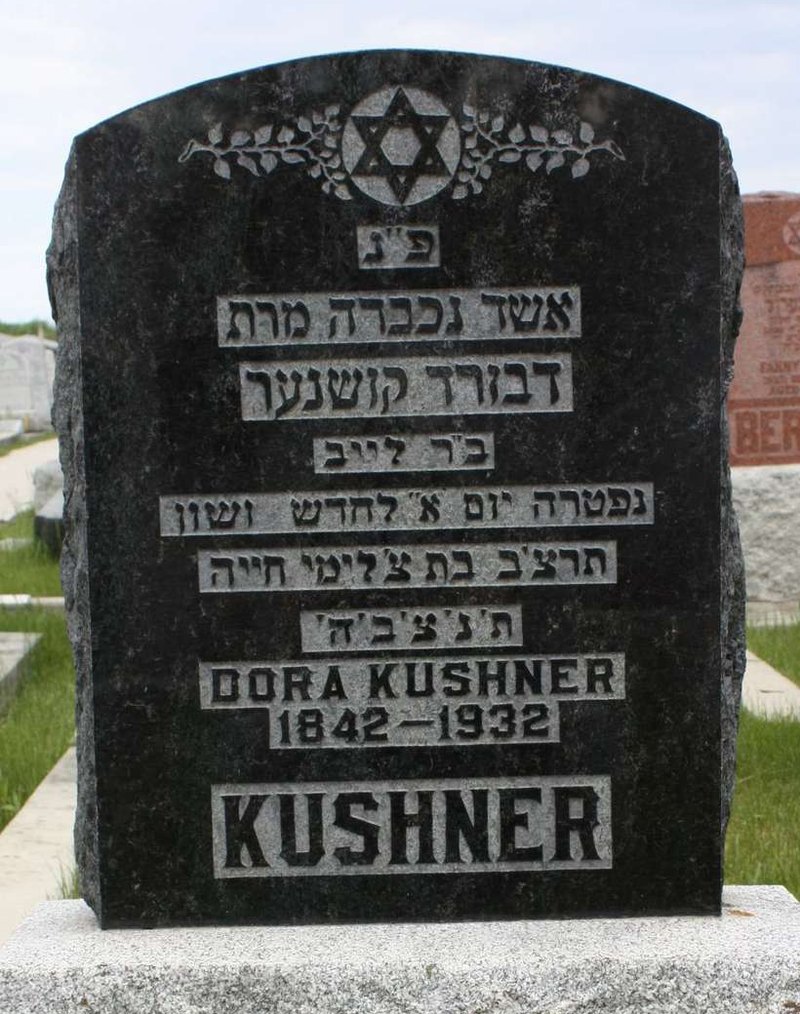
Angel was Zina's brother. His stone at Shaarey Zedek gives their father's name, Shlomo Anshel, son of Aharon, and their mother is buried a few rows away as Devorah Kushner, daughter of Leib. Born about 1842, twenty years before Eli, she died in Winnipeg in October 1932, eleven months after her great-grandson David Eli was born.
Angel's daughter Helen was the wife of Moses's brother Bennett, which almost certainly makes Sarah her first cousin, and explains how Moses met her: widowed in January 1926, he married his sister-in-law's cousin that December. Sarah's brother Arnold ended up in Arizona and her sister Esther Tulman in Los Angeles; Bessie Minuk stayed in Winnipeg.
Chapter ten · Notes
The story is built only from records that can be looked at again. Where two records disagree, the page says so or picks the better-supported one; the full evidence log with every conflict is in the research notes kept with this page. Nothing here comes from an online family tree that could not be checked against an original.
A photograph in a drawer. A ring or a watch from the shop. A story someone told about "the old country", a name of a cousin in New York, Minneapolis, Los Angeles or Toronto, a wedding invitation, a bar mitzvah picture. Anything from before 1960 is likely to answer one of the questions above. Send it to Matt and it will go on this page with your name beside it.